For more than a decade now, most of the world has accepted the grating “inevitability” of China’s political rise. People from Boston to Bogota and well beyond have watched awestruck as the country has turned in head-spinning growth rates year after year, propelled by rapidly rising exports and non-stop investment in infrastructure. In analyzing its success, pundits like Canadian academic Daniel Bell have pointed to the stunning competence of China’s leadership — a Communist Party meritocracy, he insists, that has leveraged a single-minded obsession with enhancing national greatness to create a new development model fundamentally distinct from that of the supposedly flaccid democracies.
This China-is-rising narrative has had a major impact in the developed countries, where fear of offending Beijing has reached epoch proportions, amid both political hedging and moral temporizing. The evidence for this is almost everywhere, including in major European capitals, where the Dalai Lama is now routinely shunned as a “dangerous” Tibetan “separatist” who threatens this or that humongous trade deal or this or that momentous political protocol. Even supposedly autonomous Hollywood is not exempt from China’s brutish dictates. Thus for example, the producers of Mission Impossible III dutifully excised a shot of dirty laundry hanging from a grungy Shanghai balcony, fearing that keeping the shot in their film would risk offending the delicate feelings of the Chinese people, which is something you don’t want to so. It’s often as petty as that.
Taiwan, of course, is ground zero for Chinese political pressure, with countries all around the world bending over backward to give the place as wide a berth as possible, ever mindful that to do differently invites a Chinese snit storm of biblical proportions. It’s not only that so many of these countries refuse to recognize Taiwan diplomatically, which is bad enough in itself, given the unambiguous sovereign state definition contained in the widely accepted Montevideo Convention of 1933. It’s also that they and their gutless cohorts in international organizations go out of their way to downgrade Taiwan with impunity, adopting artifices like calling Taiwanese films Chinese, or describing Taiwan as an actual Chinese province. They think this provides them advantage, which may in fact be true, but only so long as the prevailing China-is-rising narrative remains in tact. Should that narrative change — should Chinese leaders suddenly be perceived as the gang that couldn’t shoot straight instead of an otherworldly collection of Cal Tech physics professors and Académie française inductees — there would no longer be any compelling rationale to treat the country with the kind of majestic deference that is usually reserved for recently canonized saints or Nobel Peace Prize laureates. You could treat it honestly instead.
It should be pointed out here that political narratives like the China-is-rising one are very durable things, in that they take a ferociously long time to overturn. Consider, for example, the political narrative that President Ma Ying-jeou (馬英九) wisely created for himself during his first months in office in 2008, after he defeated Frank Hsieh (謝長廷) and the ghost of Chen Shui-bian (陳水扁) at the polls. Reduced to its simplest terms, it held that following a prolonged period of geopolitical brinksmanship and feckless political posturing, adult leadership was finally returning to the presidential office building, primarily in the form of a responsible statesman dedicated to lowering tensions in the Taiwan Strait and creating a win-win situation for China, Taiwan, the U.S. and everyone in between. Despite considerable evidence that the narrative’s basic premises were flawed (where, for example, was its highly touted commercial mutuality?) it stayed afloat with a vengeance, even bucking the considerable headwinds of the Sunflower Movement and China’s trenchantly aggressive behavior in Hong Kong. Indeed, it is only now, with Ma’s approval rating languishing in the teens and his Nationalist Party about to suffer a cosmic defeat at the polls, that it is finally starting to fray. People who doubt its durability need look no further than the actions of the Wall Street Journal and the BBC, which recently saw fit to send reporters to interview Ma in Taipei, as if he was some sort of vaunted political oracle. If ever there was proof of a narrative’s formidable staying power, then this was certainly it. They are very hard to undo.
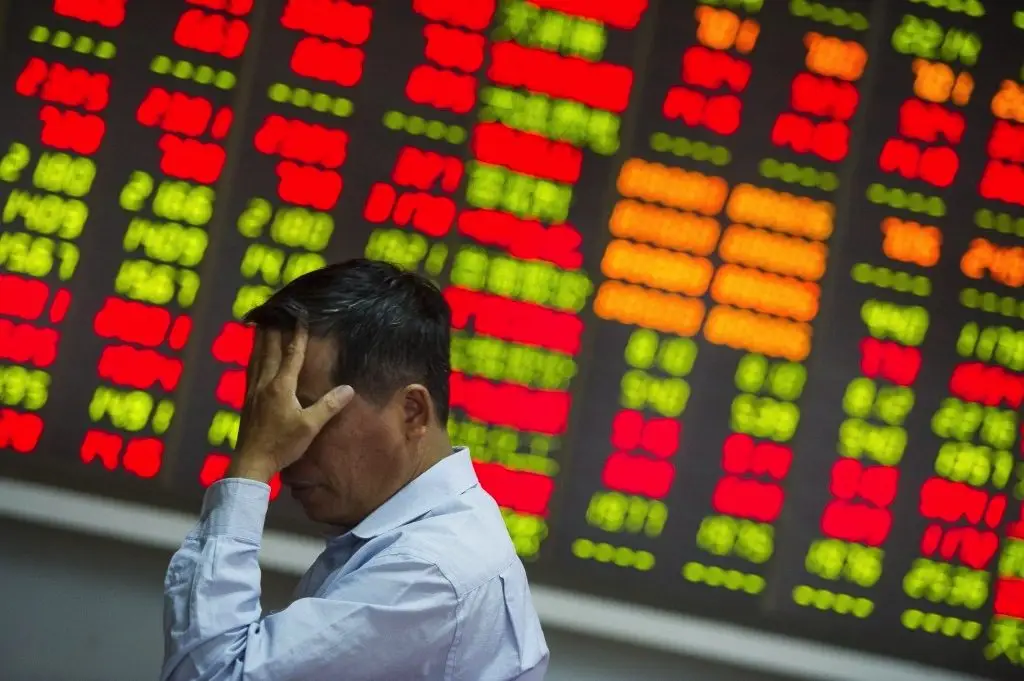
All of which brings us to the tumultuous China events of the last several weeks, during which the China-is-rising narrative has come under unprecedented attack, first from well-regarded Wall Street money mavens (who not coincidentally care mostly about their bottom lines, and so have to be taken seriously as reliable interpreters of China’s economic realities) and then from the international press, which is always looking for the new next thing. The catalyst for this assault was not so much the massive fall in Shanghai stock market valuations (which had long been expected anyway) but rather from the panicked way in which the Chinese leadership responded to them. Its loopy approach included banning short sellers from the marketplace, encouraging margin trading, stopping initial public offerings, and ordering state-owned funds and investors to buy up massive amounts of shares. When this didn’t work, it shifted its attention to the foreign exchange market, which was quite a dangerous thing. On Aug. 11 it unexpectedly devalued the renminbi by 1.9 percent, its largest such intervention in years. While it hastened to explain this move in terms of its 2013 commitment to implementing market reforms across the board, many foreign analysts regarded it far less charitably, seeing it as a desperate attempt to make Chinese exports more competitive abroad, and so jump start an obviously challenged economy that was probably running on empty anyway. This is turn led some of the analysts to begin questioning whether that economy was not in systemic crisis, fueled by falling real estate prices, cascading debt and large-scale capital flight. By late August this notion was neatly underscored by spiffy media headlines like “the great fall of China” and “China market meltdown,” the clearest sign to date that Bell’s belief in a Chinese Communist Party (CCP) meritocracy was no longer supported by facts, and that the China-is-rising narrative was possibly close to collapse.
A late August article in the prestigious Financial Times newspaper pithily summed up the bearish China mood, insisting that the biggest casualty in the China market rout was “the perception…that China’s authoritarian leaders were the world’s most competent technocrats.”
“The mishandling of a bursting stock bubble and especially the decision on August 11 to break a two-decade taboo and revalue the renminbi,” wrote FT Beijing correspondent Jamil Anderlini, “have badly shaken global faith in the Chinese model of market authoritarianism. Not only have global investors lost faith in China’s mandarins, but within China itself the reform-minded officials who have overseen the turmoil have also been widely discredited, their plans for market-oriented economic reforms now in tatters.”
Taking things even further, an Aug. 27 article in the New York Times raised probing questions about the entire Chinese development model, suggesting that the prevailing conventional wisdom that “China seemed to have a one-way trajectory, momentum that would provide a steady source of profit and capital” for foreign partners was no longer such a sure thing.
“China, while still a large and pervasive presence in the global economy,” wrote the Times’ Keith Bradsher, “is now exporting uncertainty around the world with the potential for choppier growth and volatile swings. The tectonic shift is forcing a gut check in industries that have built their strategies and plotted their profits around China’s rise.”
Taken together the Financial Times and New York Times articles were a strong indication that for the first time in more than 10 years the China-is-rising narrative had hit seriously choppy waters, not only on Wall Street and in the City of London, but also in wider swathes of the elite opinion making community, which is arguably even more important. To be sure, the narrative still has a lot of subscribers, including well regarded economists like Nick Lardy, who continue to insist that annual Chinese growth rates in excess of 5.5 or six percent can be sustained over the long term, and that ongoing reform efforts aimed at transforming China into a consumer-led economy are well on track to succeed.
But Lardy’s optimism aside, there is now a growing sense of doubt about China’s political rise, once seen as so inevitable. It is still in its early stages, so it is hard to say for sure whether it will have a decisive impact in undermining the threats that China has brought to bear against its international interlocutors and other members of the international community over the past decade or so. Making such a determination will require considerably more evidence than we now have at our disposal about Beijing’s latest bout of economic turmoil and the quality of its leadership. But if that turmoil persists, then China is heading for trouble, and so too is the China-is-rising narrative, which in recent years has done so much to stymie Taiwan’s international development, to say nothing of the moral compass of the world community as a whole. The sooner it is neutralized the better it will be for everybody, including for the Chinese people themselves, who have suffered so egregiously under CCP rule.
5 comments
This article is more about hope than facts. A pathetic propaganda piece.
It’s not really fair to pick on Daniel Bell. He teaches in China, so of course he’s going to be a cheerleader.
“to say nothing of the moral compass of the world community as a whole.” –good point
This is now the best article published on Thinking-Taiwan. From a realist investor’s viewpoint, this is completely outstanding. Brilliant analysis and quotations.
“govildev,” please spend your “wu shi mao” wisely.
This article feels like the inverse of all those “OMFG CHINA’S THE WORLD’S BIGGEST ECONOMY NOW!!!!!” that did their best to skirt around the fact that it was only in PPP and even then possibly not actually true. It’s waaaaaaay too early to jump on a “China’s rise is over” narrative. This stock market/currency valuation mess is definitely a stern (and apparently for many, needed) reminder that the CCP leadership is full of mere mortals but we’re a long ways off from China being stuck in the middle income trap.
Peter Huang
Just now ·
“The Changing China Narrative”
【Comment】: 1)Not other country does not like to recognize Taiwan as a country, on the contrary, most countries like to recognize Taiwan as a nation, for Taiwan’s strategic status. 2) For business with China when the country wants to diplomatic relation with China she is asked to choose one, China or Taiwan, no parallel existence of both. So the country is oppressed to recognize China and severe diplomatic relation with Taiwan. Is it a selfish decision? Maybe, but she can not but make that choice. There is only Canada, when asked to do so she righteously rejects that request. Because Canada is not Taiwan and can not decide Taiwan’s fate. If every country wants to have diplomatic relation with China has that bone to deal with China Taiwan could be a country.
Comments are closed to new replies.